
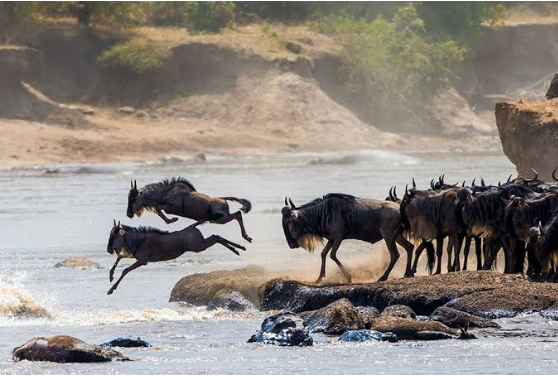

East Africa offers two wildlife experiences that rank among the best on Earth. One is intimate and quiet: an hour in a misty forest with a family of mountain gorillas or a troop of chimpanzees. The other is vast and dramatic: more than a million wildebeest, along with zebra and gazelle, moving across the Serengeti-Mara ecosystem in a continuous, circular journey.
Done separately, each is memorable. Combined in one itinerary, primate safaris and the wildebeest migration make one of the most complete wildlife journeys in Africa. This guide explains how each experience works, where to go, when to travel, and how to link them without wasting time or money.
Understanding the Wildebeest Migration
What It Is
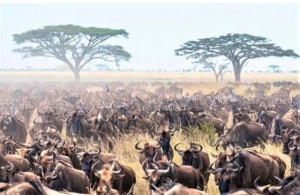
The Great Migration is the year-round movement of roughly 1.5 million wildebeest, accompanied by hundreds of thousands of zebra and gazelle, through the Serengeti in Tanzania and the Masai Mara in Kenya. The herds follow the rains and the fresh grass that grows after them. There is no single start or end date, only a continuous clockwise cycle.
Predators follow the herds. Lions, cheetahs, leopards, hyenas and crocodiles all take advantage of the abundance, so the migration is as much a story about predation as it is about grazing.
The Seasonal Cycle
- January to March: The herds gather on the southern Serengeti and Ndutu plains. Calving season brings hundreds of thousands of newborns in a few weeks, and predators are active.
- April to May: Herds begin moving north and west through the central Serengeti as the long rains arrive. Landscapes are green and crowds are light.
- June to July: Animals move through the western corridor and approach the Grumeti River, where crocodile-guarded crossings can occur.
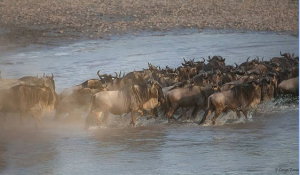
- July to October: The northern Serengeti and the Masai Mara see the famous Mara River crossings. This is the most photographed phase of the migration.
- November to December: Herds turn south again as the short rains begin, heading back toward the southern plains.
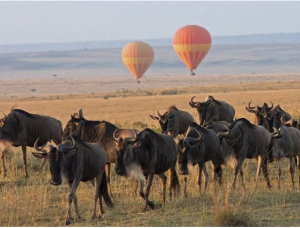
Because the animals follow rain rather than a calendar, timing varies from year to year. A good operator watches current conditions and positions you accordingly.
Understanding Primate Safaris
The Great Apes
Mountain gorillas live in only two areas: Uganda’s Bwindi Impenetrable Forest and Mgahinga, and Rwanda’s Volcanoes National Park, part of the same Virunga landscape. Trekking involves hiking into the forest with trackers and rangers and spending an hour with a habituated family under strict viewing rules.
Chimpanzees can be tracked in several places:
- Uganda: Kibale Forest, Kyambura Gorge and Budongo Forest
- Rwanda: Nyungwe National Park
- Tanzania: Mahale Mountains and Gombe Stream National Park, both on the shores of Lake Tanganyika
Other Primates
Primate safaris are not only about great apes. Golden monkeys in the Virunga volcanoes, colobus monkeys in Nyungwe, red-tailed and blue monkeys in Uganda’s forests, and olive baboons across the savanna all add variety to an itinerary.
Why Primate Tourism Matters
Permit fees fund anti-poaching patrols, veterinary care and community projects. Mountain gorilla numbers have grown over recent decades, in part because tourism gives local people and governments a reason to protect the forests.
Why Combine Primates and the Migration?
Contrast. The Serengeti is wide, open and dramatic. The gorilla forests are enclosed, quiet and intimate. Seeing both gives you two completely different sides of East Africa.
Variety. A single trip can include big cats, elephants, great apes and the migration, which is hard to match in any other region.
Efficiency. Flying into East Africa once and linking two or three destinations is far more cost-effective than making separate trips.
Balance. Savanna game drives are comfortable and largely vehicle-based. Primate trekking is active and physical. Many travelers like the rhythm of alternating between them.
Three Ways to Combine Them
Option 1: Tanzania Only (Serengeti and Chimpanzees)
Tanzania alone offers the migration plus chimpanzee tracking in the west. Mahale and Gombe are remote, usually reached by light aircraft and boat, so they suit travelers who want a quieter, off-the-beaten-track extension.
Best for: travelers who want to stay within one country and enjoy a remote, wilderness-style finish.
Option 2: Tanzania and Rwanda (Migration and Gorillas)
Many travelers fly between Tanzania and Rwanda by connecting through regional hubs such as Nairobi, Entebbe or Kigali, depending on available schedules. Volcanoes National Park is only a couple of hours from Kigali, so the gorilla leg is quick and efficient.
Best for: travelers with limited time who want gorillas without a long overland journey.
Option 3: Tanzania and Uganda (Migration, Gorillas and Chimps)
Uganda offers the widest range of primates, with gorillas in Bwindi, chimpanzees in Kibale, and golden monkeys in Mgahinga, plus classic wildlife in Queen Elizabeth and Murchison Falls. It tends to have a lower gorilla permit cost than Rwanda.
Best for: travelers who want maximum primate variety and are happy with longer road transfers.
A fourth possibility is pairing the Masai Mara in Kenya with Rwanda or Uganda, which is practical because Nairobi has strong regional connections.
Sample Itineraries
10-Day Serengeti and Rwanda Gorillas
Arrive in Arusha, spend 5 to 6 nights in the Serengeti and Ngorongoro, then connect via a regional hub to Kigali. Finish with a gorilla trek in Volcanoes National Park and golden monkey tracking.
12-Day Migration and Uganda Primates
Start with the Serengeti (6 nights), connect to Entebbe, then head to Kibale for chimpanzees and Bwindi for gorillas, finishing with a rest day near the forest.
14-Day Ultimate East Africa
Tanzania’s northern circuit, then Uganda or Rwanda for gorillas, and optionally Nyungwe or Kibale for chimpanzees. This itinerary gives a comprehensive view of the region’s headline wildlife.
Best Time to Combine Both
The ideal window depends on what you most want to see.
July to September is often the best overall. The northern Serengeti and Masai Mara offer migration river crossings, and the dry-season conditions make gorilla and chimpanzee treks easier underfoot. It is also the busiest and most expensive time, so booking early is essential.
January to March is perfect for the calving season on the southern plains. Gorilla trekking is still possible year-round, though some forest trails may be wetter.
April to May and November are the quietest, wettest months. Rates are lower, but trails can be muddy and some camps may close.
The key point is that gorillas can be seen throughout the year. This gives you flexibility to plan around the migration rather than the other way around.
Budget Considerations
Costs vary widely, but a few principles help you plan:
- Gorilla permits are a major fixed cost. Rwanda’s permit is about $1,500 per person, while Uganda’s is about $800, with a discounted rate in some low-season months. Rates can change, so confirm before booking.
- Serengeti park fees add up. Entry, concession and vehicle fees are charged per day, and they are not negotiable.
- Luxury camps in prime migration areas command premium prices, especially July to October and during calving.
- Regional flights and transfers are a meaningful extra cost on a multi-country trip.
- Visas and insurance should be factored in early. East Africa has e-visa options and, for some travelers, a joint tourist visa for certain countries.
A combined trip of about two weeks typically costs significantly more than a Serengeti-only safari, so decide early where to prioritize your budget.
Practical Tips
Book permits and camps early. Gorilla permits are limited, and top migration camps fill up many months in advance.
Prepare for the physical difference. Savanna game drives are easy on the body, while gorilla treks can involve steep, muddy terrain at altitude. Fitness preparation helps.
Pack for two climates. You will need light, neutral safari clothing for the plains, plus waterproof boots, long sleeves, gloves and a rain jacket for the forest.
Mind luggage limits. Light aircraft often restrict you to soft bags of around 15 kg.
Follow health and conduct rules. Do not trek if you are ill, keep the required distance from primates, and avoid flash photography.
Use an operator who knows the region. Cross-border logistics, permits and flights are much smoother with an experienced planner.
Conclusion
Primate safaris and the wildebeest migration complement each other in a way few other travel experiences do. The migration shows nature on its grandest scale, with open plains, enormous herds and the drama of predation. The primate forests reveal a quieter, more personal side, where eye contact with a gorilla or chimpanzee feels strikingly human. By timing your trip around the migration’s movements, choosing the right countries for the primate leg, and planning logistics carefully, you can enjoy both in a single seamless journey. With good preparation and a trusted operator, it will be a trip you remember for the rest of your life.
Key Takeaways
- The migration involves about 1.5 million wildebeest moving in a continuous cycle through the Serengeti and Masai Mara.
- Mountain gorillas live only in Uganda and Rwanda (in this region’s tourism circuit), while chimpanzees can be tracked in Uganda, Rwanda and western Tanzania.
- Popular combinations include Tanzania plus Rwanda for speed and Tanzania plus Uganda for maximum primate variety.
- July to September is the most popular time overall, while January to March is best for calving.
- Gorilla trekking is possible all year, so the migration should usually drive your timing.
- Gorilla permits cost roughly $800 in Uganda and $1,500 in Rwanda, and rates can change.
- Book 9 to 12 months ahead for peak migration season and permits.
Frequently Asked Questions
- Can I see gorillas and the wildebeest migration on the same trip?
Yes. Many travelers combine the Serengeti or Masai Mara with gorilla trekking in Rwanda or Uganda, typically over 10 to 14 days. - When is the best time to combine them?
July to September is popular for river crossings and drier forest trails. January to March suits calving season. Gorilla trekking is available year-round. - Which is better for gorillas, Uganda or Rwanda?
Uganda has lower permit costs and more variety, while Rwanda is faster to reach and well organized. The right choice depends on your budget, time and interests. - Can I see chimpanzees in Tanzania?
Yes. Mahale Mountains and Gombe Stream National Park offer chimpanzee tracking, though they are remote and usually require flights and boat transfers. - How many days do I need?
At least 10 days for a Serengeti-plus-gorillas trip, and 12 to 14 days if you want to add more primates or parks. - Is the migration the same every year?
The overall cycle is consistent, but exact timing and location change with rainfall. Flexible planning and good local advice help. - How physically demanding is gorilla trekking?
It can be demanding, with steep, muddy trails at altitude, and trek times vary from a couple of hours to most of the day. Porters are available. - What is the minimum age for gorilla trekking?
15 in both Uganda and Rwanda. - How much does a combined trip cost?
It varies widely by season and style. Expect it to cost considerably more than a single-country safari because of permits, regional flights and multiple park fees. Ask for an itemized quote.
Note: Prices, permit rules and migration timing change. Treat the figures here as planning estimates and confirm current details with a licensed operator or park authorities before booking.
I can also put this into a Word doc or a ready-to-publish web page if you’d like.